
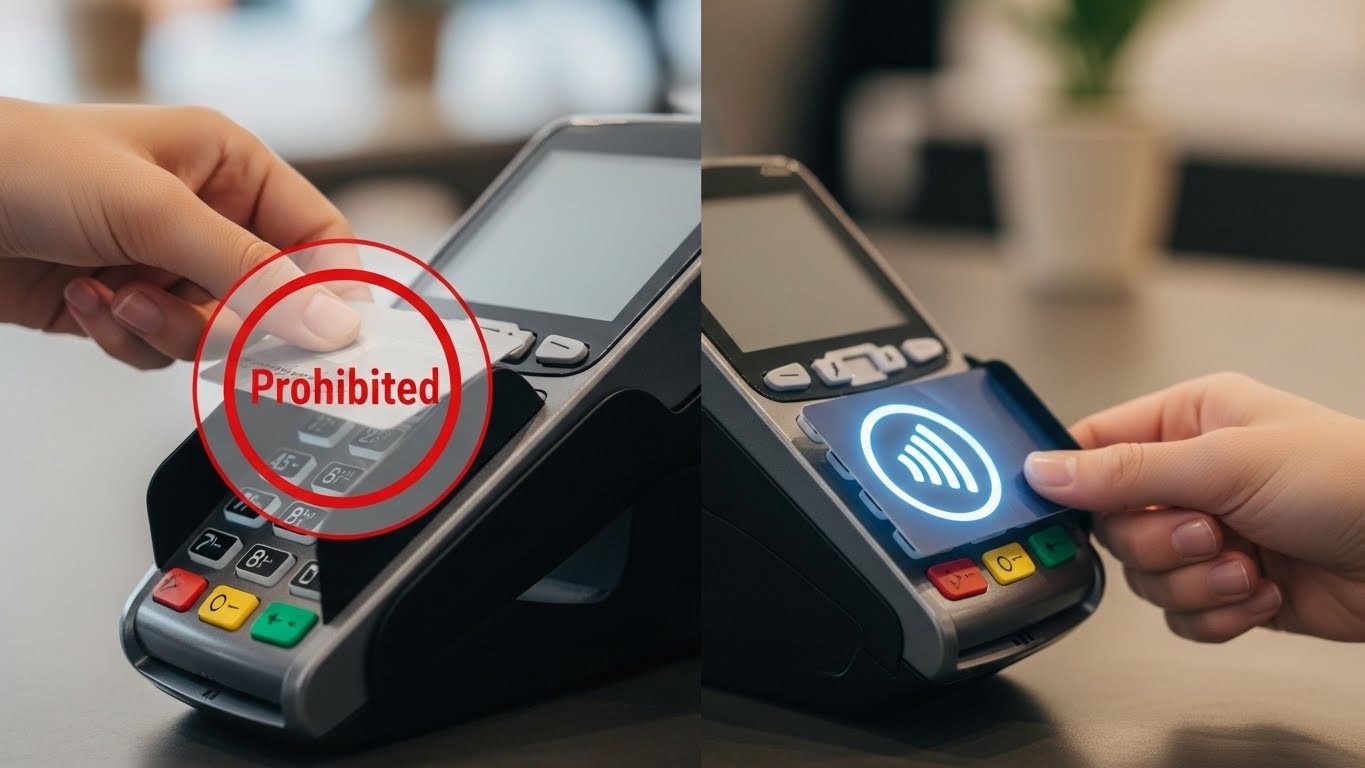
If you’ve visited a store recently, you may have noticed that many card readers are starting to cover up their “swipe” slots with tape or plastic guards. This isn’t just a technical glitch; it is a major shift in how we keep our money safe.
As we move through 2026, the traditional “swipe” method is being phased out globally. Major card networks like Mastercard have already begun removing magnetic stripes from new cards in many regions. At FixMyCard.com, we want to help you understand why “swiping” is now considered a high-risk activity and why using your card’s Chip or “Tap” feature is the best way to stay protected.
Common reasons why swiping is risky
The thin brown or black stripe on the back of your card—the magnetic stripe—technology is over 60 years old. In many cases, it is the weakest link in your financial security.
- Static Data: The magnetic stripe stores your card information in a “static” format. This means the data never changes. If a criminal copies the stripe, they have everything they need to create a “clone” of your card.
- Vulnerability to Skimming: Skimmers are small, illegal devices that fit over a card slot. When you swipe, these devices “read” the static data instantly. Because swiping requires the card to slide through a physical channel, it is very easy for a skimmer to capture your info without you noticing.
- The “Fallback” Scam: Fraudsters sometimes intentionally damage a card reader’s chip slot to force you to swipe. This is known as a “fallback” transaction, and it is a common tactic used to steal data from newer cards.
Technical causes: Why Chip and Tap are safer
Modern payment methods like EMV Chips (inserting the card) and Contactless Tap (NFC) use a technology called Tokenization.
- Unique Transaction Codes: Unlike the magnetic stripe, the chip generates a “one-time” code for every single purchase. If a hacker intercepts that code, it is useless for any future transactions.
- Encrypted Communication: When you “Tap” your card or phone, the data sent to the terminal is encrypted. This makes it almost impossible for “shimmers” (the newer version of skimmers) to steal usable information.
- No Physical Contact: With “Tap-to-Pay,” your card never enters a slot where a physical device could be hiding. This reduces the risk of “shimming” and also keeps your card from wearing out.
What users can check themselves
To ensure you are using the most secure method available, you can check these settings today:
- Look for the “Wave” Symbol: Check your card for four curved lines (like a Wi-Fi symbol). This means your card is “Contactless” and can be tapped.
- Enable Mobile Wallets: Adding your card to Apple Pay or Google Pay is often even safer than using the physical card, as it uses biometric locks (FaceID or Fingerprint).
- Inspect the Terminal: Before swiping (if you absolutely must), give the card reader a quick wiggle. If any part feels loose or bulky, it might have a skimmer attached.
- Update Your Card: If your card only has a magnetic stripe and no chip, contact your bank to request a modern replacement.
Frequently Asked Questions
Why does my card still have a magnetic stripe at all? In many cases, stripes are kept for “backward compatibility” in case you travel to a region that hasn’t updated its technology yet. However, this is rapidly changing in 2026.
Is it safe to retry a swipe if the chip fails? If the chip fails, the terminal may ask you to swipe. While this is sometimes a technical error, be cautious. If the machine looks tampered with, it is safer to use a different terminal or a different payment method.
Can someone “steal” my card info by walking past me with a scanner? This is a common concern, but in reality, it is extremely difficult. Contactless technology only works within 1-2 inches, and the data it sends is encrypted and unique to that “fake” transaction.
Will swiping my card eventually be impossible? Yes. Major networks have a timeline to remove stripes entirely by the 2030s, and many merchants are already disabling the swipe function on their machines for security.
Is tapping faster than inserting the chip? Yes. In many cases, a “tap” takes less than two seconds, whereas a “chip dip” requires the card to stay in the machine while the bank verifies the transaction.
When to contact the bank
You should call your bank or card issuer if:
- Your card’s chip is physically damaged and no longer works.
- You noticed a “Swipe” transaction on your statement that you didn’t authorize.
- Your bank’s app sends you a notification about a “Magnetic Stripe Transaction” that you didn’t perform.
When you call, simply explain that you suspect your magnetic stripe was skimmed, and they can issue you a more secure replacement.
Conclusion
While the “swipe” served us well for decades, it is no longer the safest way to pay in 2026. By choosing to “Tap” or “Chip,” you are using the latest encryption technology to build a wall around your bank account. It is a small change in habit that provides a massive boost to your financial security.
Disclaimer: This article is for informational purposes only. FixMyCard.com is not a bank or financial institution. For account-specific issues, please contact your bank or card issuer directly.
Recommended Reading
If you found this guide helpful, you might also want to check out these related security and card-fixing tips:
- Protect Your Money: How to Secure Your Cards Against “Agentic” AI Scams
Learn how to defend your account from the latest 2026 fraud tactics that target automated payments. - Contactless Limit Reached? Why Your Card is Asking for a PIN
Using “Tap-to-Pay” for the first time? Understand why your bank might ask for a PIN after a certain number of contactless transactions. - New 2026 Biometric Rules: Why Your Card Might Need a “Face-to-Face” Check
Find out how new regulations are changing the way cards are verified in Southeast Asia and beyond.
Sources:
- Mastercard Newsroom: The Transition Away from Magnetic Stripes
- EMVCo: Technology Standards for Secure Payments
- PCI Security Standards Council: Protecting Against Skimming
- HackerRead / Cybersecurity News: Modern Skimming Trends in 2026
- Forbes Advisor / NerdWallet: Card Security Trends for 2026