
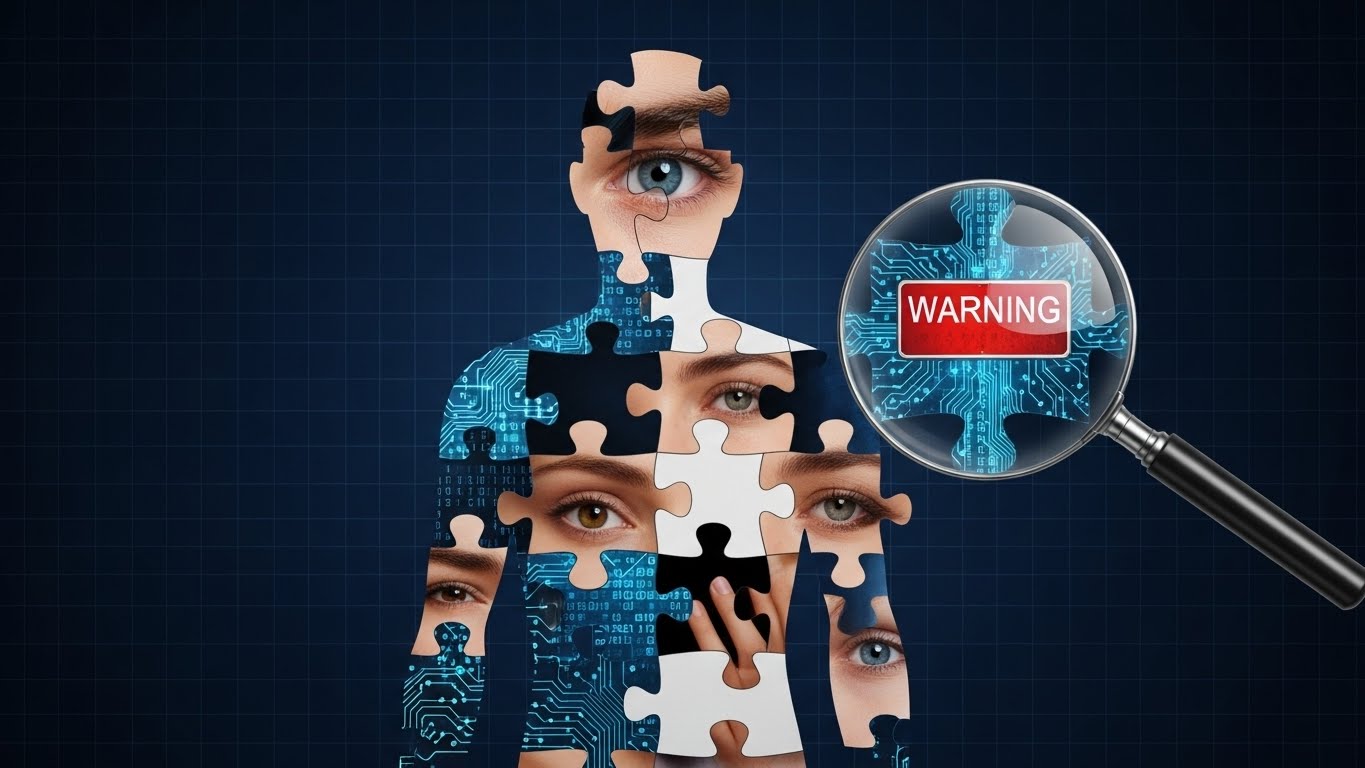
In 2026, the most dangerous thief isn’t the one who steals your wallet—it’s the one who steals just a single piece of your data to create a “ghost.” This is Synthetic Identity Fraud (SIF), and it has become the fastest-growing financial crime of the year.
Unlike traditional identity theft, where a criminal pretends to be you, in synthetic fraud, the criminal creates a “Frankenstein ID.” They combine real information (like a Social Security number or a National ID) with fake information (a different name, address, and phone number).
At FixMyCard.com, we are seeing a 60% surge in these cases because, for the first time, AI is being used to “cultivate” these fake people over many months before they strike.
How a “Frankenstein ID” is Built
Scammers in 2026 use a sophisticated three-step process to build these fake identities:
- The Harvest: They find “dormant” identifiers—often from children, the elderly, or people who haven’t used credit in years. Because these IDs have no credit history, they are a “blank canvas.”
- The Cultivation: The fraudster opens a small account (like a store card or a “buy now, pay later” line) using the fake name but the real ID number. Over 6–12 months, they pay bills on time. To the banks, this looks like a “new, responsible borrower” entering the system.
- The Bust-Out: Once the “ghost” has a high credit score and a $50,000 credit limit, the criminal maxes out every card and disappears.
Why this hurts YOU (The Real Person)
You might think, “If they used a fake name, why does it matter to me?” * Identity Collision: Eventually, the credit bureau sees two different names linked to the same ID number. Your real credit report becomes “merged” or “polluted” with the fraudster’s debts.
- The Invisible Decline: You might go to apply for a car loan or a new credit card in 2026 and get an instant “Declined.” When you ask why, you find out you have a “fraud alert” on your file that you never knew about.
- The Cleanup Headache: Because there is no “direct victim” (the fake person doesn’t exist), it is much harder to prove to a bank that the debt isn’t yours.
2026 Technology: Behavioral Analytics
The good news is that banks have upgraded their defenses. In 2026, banks no longer just look at what you type; they look at how you type.
- The “Human Jitter”: Scammers often use automated bots to fill out credit applications. Banks now look for the tiny “jitters” in mouse movements and the inconsistent speed of human typing. A synthetic bot is “too perfect,” which triggers an alarm.
- Digital Footprint Analysis: If a “new borrower” has a 750 credit score but zero social media presence, no history of a phone number, and no “digital trail” older than six months, the 2026 AI security models will flag them as a “Synthetic Risk.”
What users can check themselves
To protect your “Invisible Identity,” do these three things this week:
- Check Your “Inquiry” History: Look at your credit report for names you don’t recognize or addresses in cities you’ve never lived in. These are signs of a “Merged File.”
- Freeze Your Child’s Credit: Since children are the #1 target for synthetic fraud (because their IDs are “clean”), many parents in 2026 are preemptively “freezing” their children’s credit until they turn 18.
- Monitor “Government Letters”: If you receive mail from the tax office or a bank addressed to a name you don’t know but at your home address, do not just throw it away. It could be a fraudster “verifying” a synthetic identity using your location.
Frequently Asked Questions
Is synthetic fraud more common than regular identity theft? Yes. In 2026, it is estimated that nearly 50% of all credit losses in the banking sector are actually hidden synthetic fraud cases.
Can I fix my credit score if it’s polluted by a synthetic ID? Yes, but it requires a “Manual File Separation” by the credit bureau. You will likely need to provide proof of your identity (passport/ID card) to show you are the “Original” owner of the ID number.
Do scammers use AI to create these identities? Absolutely. Scammers use Generative AI to create hyper-realistic “employer records,” “rental agreements,” and even fake LinkedIn profiles to make the “ghost” person look real to the bank.
When to contact the bank
Contact your bank’s fraud department if:
- You are denied credit for no obvious reason despite a good history.
- You see “Authorized User” accounts on your report that you didn’t add.
- You receive a “Welcome to our Bank” letter for a name that isn’t yours.
Recommended Reading
- [Stop Deepfake Scams: Why Your Bank App Needs More Than Just a Face Scan] Learn how synthetic identities use deepfakes to pass “live” video checks.
- [KHQR Cross-Border Update 2026: A Guide for Travelers] See how modern QR systems are designed to be “Synthetic-Proof” through real-time bank verification.
- [The 2026 January Debt Hangover: How to Clear Your Balance] Make sure your own debt is managed so it doesn’t look like a “Bust-Out” pattern to the bank’s AI.
Mandatory Disclaimer This article is for informational purposes only. FixMyCard.com is not a credit bureau or legal firm. If you believe your identity has been used in a synthetic fraud scheme, please contact your local law enforcement and credit reporting agency immediately.
Sources:
- The Credit Card AI Crime Wave, and How to Fight Back in 2026
- What Is Synthetic Identity Fraud: How to Detect & Prevent Against It?
- Synthetic Identity Fraud: What It Is & How to Prevent It
- Behavioral Analytics 101: What Is Behavioral Analytics in Fraud?
- What Is Synthetic Identity Fraud: How to Detect & Prevent Against It?
- More Sophisticated—and More AI-Driven—Than Ever: Top Identity Fraud Trends to Watch in 2026